

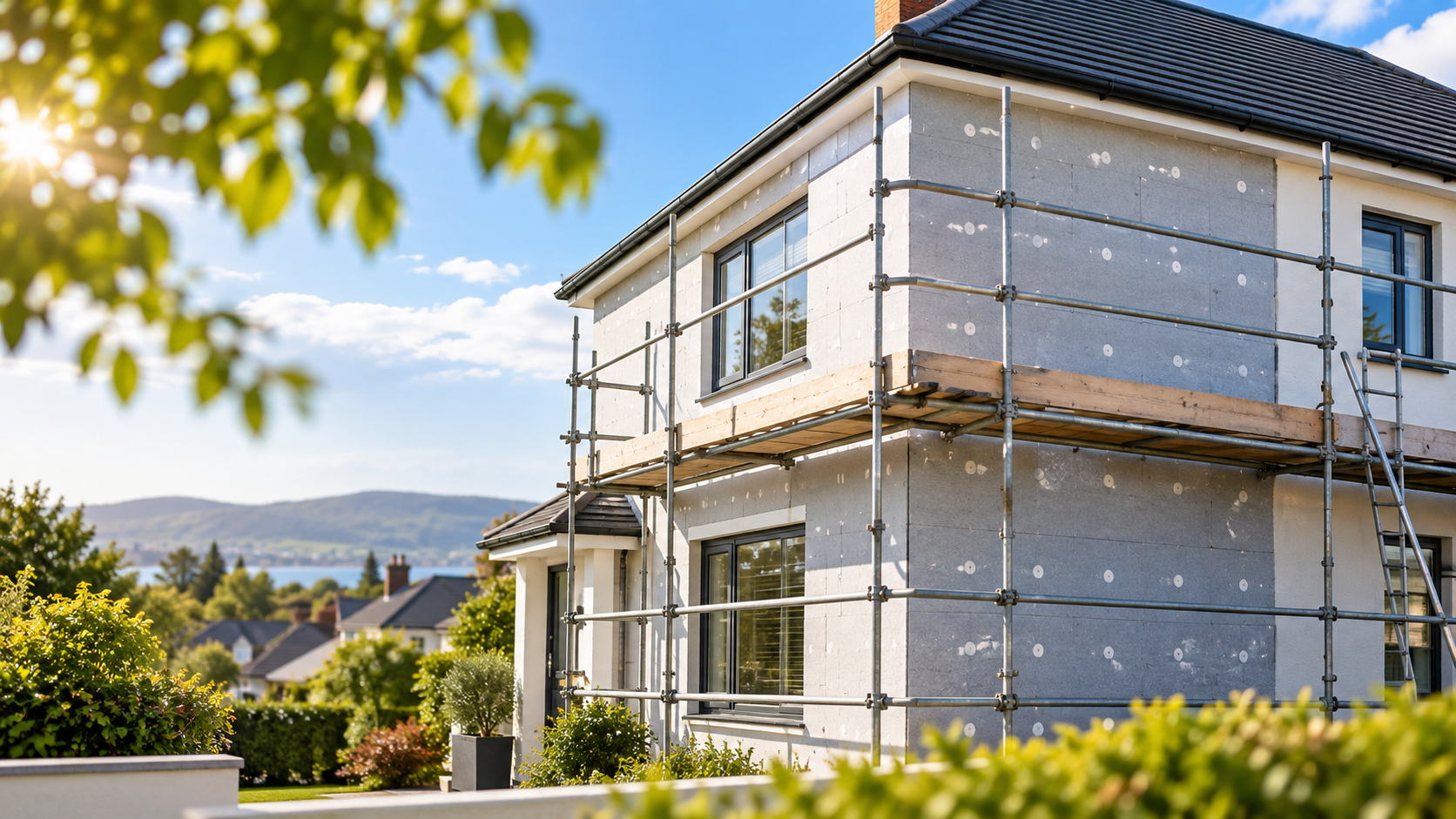
If your home feels cold even when the heating is on, poorly insulated external walls could be one of the main reasons.
External wall insulation, often referred to as external insulation, EWI or wrapping a house can significantly improve the thermal performance of an older Irish home. It can help retain heat, improve comfort and reduce the amount of energy needed to keep your home warm.
But how much does external wall insulation cost in Ireland in 2026?
The answer depends heavily on the size and type of your property, the amount of exposed external wall area, access requirements and the condition of the existing walls.
As a useful benchmark, SEAI‘s published median-cost data shows external wall insulation costs of approximately €13,500 for a mid-terrace, €23,333 for a semi-detached/end-of-terrace property and €24,000 for a detached house.
SEAI grants of up to €8,000 are currently available towards external wall insulation, depending on your property type.
External Wall Insulation Costs in Ireland
There isn’t one fixed price for external wall insulation.
The overall cost will depend on factors including:
- The size of your home
- The total external wall area
- Whether the property is detached, semi-detached or terraced
- The number of storeys
- Scaffolding and access requirements
- Existing wall condition
- Insulation specification
- Required ventilation measures
- Window sills, pipes, cables and other external fittings
- The final render and finish
SEAI’s published median costs provide a useful indication of what homeowners have actually paid for completed projects.
| Property Type | SEAI Median Cost | SEAI External Wall Insulation Grant |
|---|---|---|
| Apartment | €15,750* | €3,000 |
| Mid-Terrace House | €13,500 | €3,500 |
| Semi-Detached / End-of-Terrace | €23,333 | €6,000 |
| Detached House | €24,000 | €8,000 |
*SEAI notes that its apartment median-cost figure was based on a small number of applications and should therefore be treated with caution.
These are median figures rather than quotations. The actual cost of insulating your property may be higher or lower depending on the home.
How Much Is External Wall Insulation Per Square Metre in Ireland?
External wall insulation is often discussed in terms of cost per square metre.
Current Irish market guides commonly put external wall insulation at approximately €110–€160 per m², including VAT, although the actual cost will depend on the system, property and complexity of the installation.
For example, two houses with the same floor area can have very different external insulation costs.
A mid-terrace property may only have exposed walls at the front and rear, whereas a detached property can have four exposed elevations.
That’s why a proper assessment of the property is more useful than simply multiplying the home’s floor area by a standard rate.
How Much Is the SEAI Grant for External Wall Insulation in 2026?
SEAI currently provides fixed grants towards external wall insulation.
The available grant depends on the type of property:
Detached house – €8,000
Semi-detached or end-of-terrace house – €6,000
Mid-terrace house – €3,500
Apartment – €3,000
For insulation grants, the property generally needs to have been built and occupied before 31 December 2010.
SEAI also requires all external walls of the property to be fully insulated to qualify for the external wall insulation grant. Simply insulating one or two external walls does not qualify as a whole-surface external insulation solution.
Eligibility and grant conditions should always be confirmed before beginning works.
How Much Does External Wall Insulation Cost After the SEAI Grant?
Using SEAI’s published median costs gives us a useful illustration.
A semi-detached or end-of-terrace house has a published median external insulation cost of approximately €23,333.
With a potential €6,000 SEAI grant, that would leave approximately €17,333 before considering any other costs, supports or project-specific factors.
For a detached house, SEAI’s median cost is approximately €24,000.
With the €8,000 external wall insulation grant, the equivalent figure would be approximately €16,000.
These examples are illustrative only. Every property is different, and the final cost needs to be established following an assessment and detailed quotation.
What Is External Wall Insulation?
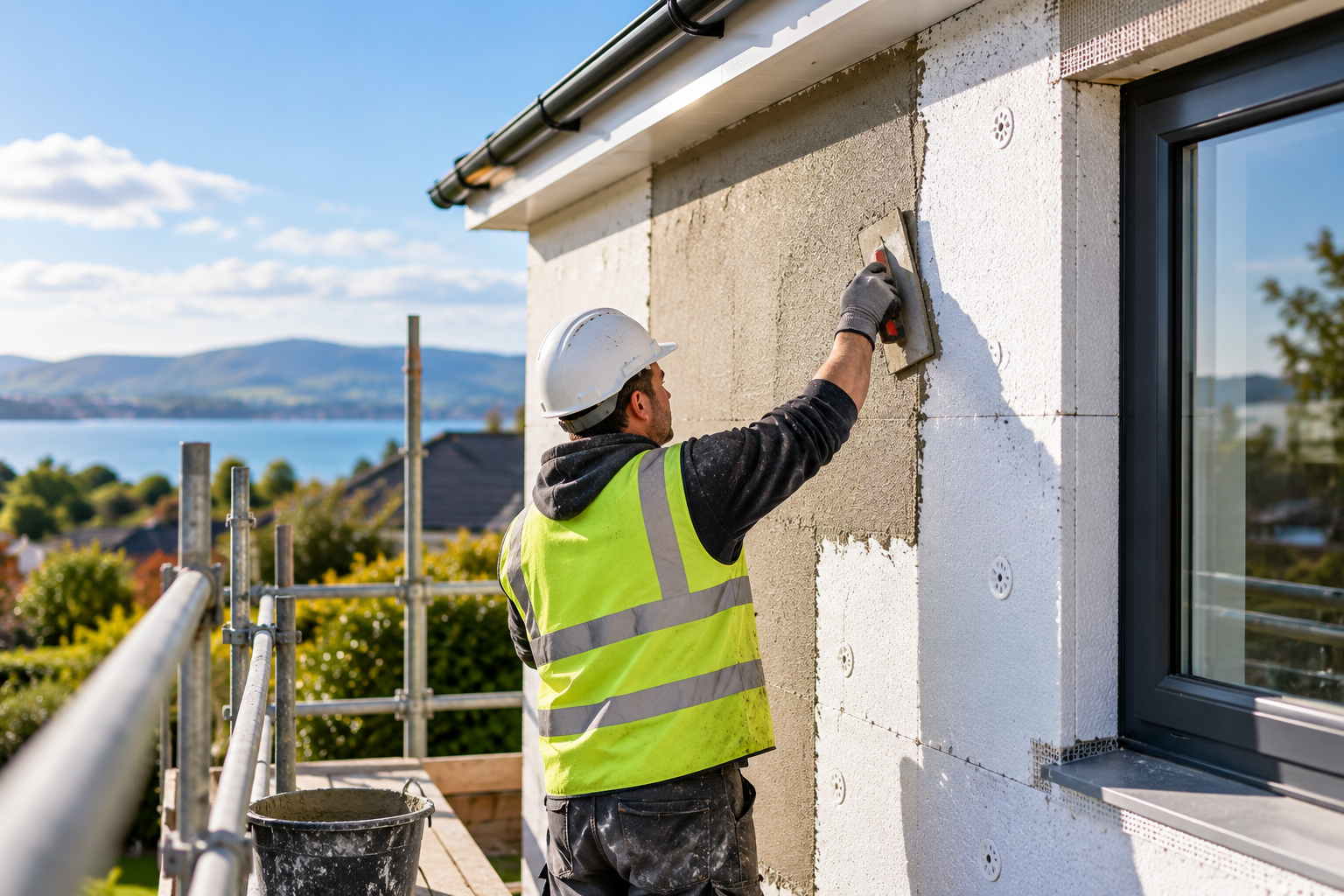
External wall insulation involves fixing an insulating layer to the outside of the external walls of your home.
A reinforced layer and protective rendered finish are then applied over the insulation.
Think of it as creating an additional thermal layer around your house.
This reduces the amount of heat passing through the external walls while allowing the internal floor area of the property to remain largely unaffected.
For suitable homes, it can be one of the most significant improvements you can make to the building fabric.
What Are the Benefits of External Wall Insulation?
A warmer home
Insulating the external walls reduces heat loss through the building fabric, helping rooms remain warmer for longer.
Lower energy demand
When your home retains heat more effectively, your heating system doesn’t need to work as hard to maintain a comfortable indoor temperature.
The actual savings will vary according to the property, heating system, thermostat settings and household energy use.
Improved BER
External wall insulation can contribute significantly towards improving your home’s Building Energy Rating (BER).
It can be particularly important as part of a larger retrofit designed to bring an older D-, E-, F- or G-rated property towards a much higher energy rating.
No major loss of internal floor space
Internal wall insulation involves installing insulation on the inside of the external walls.
External insulation is installed outside instead, meaning you don’t lose the same amount of internal floor area.
A new exterior finish
Because a new rendered finish forms part of the system, external insulation can also dramatically change the appearance of an older property.
Is External Wall Insulation Suitable for Every House?
No.
This is why we wouldn’t recommend deciding on external insulation purely from an online price estimate.
Different Irish homes require different approaches.
Depending on the construction of your property, alternatives can include:
- Cavity wall insulation
- Internal insulation or dry lining
- External wall insulation
- A combination of appropriate measures
The age and construction of the house are particularly important.
A home built in the 1970s may require a very different approach from a solid-wall property built in the 1930s.
A Home Energy Assessment can establish the existing construction and energy performance of the property and identify the upgrades that are appropriate for the home.
External Wall Insulation vs Internal Insulation
Both approaches are designed to reduce heat loss through external walls, but they work differently.
External wall insulation is installed on the outside of the property.
Internal insulation, often called dry lining, is installed on the inside face of the external walls.
External insulation can have advantages because it creates a more continuous thermal envelope and doesn’t reduce internal floor area.
However, external insulation may not always be suitable due to the property’s construction, boundaries, architectural features, planning considerations or other practical restrictions.
Internal insulation may therefore be a better solution for some properties.
The right choice should be based on the house rather than simply choosing whichever option has the lowest initial cost.
External Wall Insulation and Heat Pumps
Wall insulation becomes particularly important when homeowners are considering a heat pump.
Heat pumps generally perform best in homes with low levels of heat loss.
For an older poorly insulated property, that can mean improving the building fabric before, or as part of, installing the heat pump.
External wall insulation may therefore form part of a wider retrofit package alongside measures such as:
- Attic or roof insulation
- Air tightness improvements
- Ventilation
- Windows and doors
- Heat pump installation
- Heating system upgrades
- Solar PV
The combination required will depend on the individual home.
Can External Wall Insulation Be Included in a One Stop Shop Retrofit?
Yes.
External wall insulation can form part of a wider SEAI One Stop Shop home energy upgrade.
Rather than organising each measure separately, a One Stop Shop can coordinate the energy upgrade project and manage the relevant grant process.
Through the One Stop Shop route, qualifying grants are deducted from the cost of the project rather than the homeowner having to separately claim each grant afterwards.
This can be particularly useful when external wall insulation is being completed alongside upgrades such as a heat pump, ventilation, attic insulation, windows or solar PV.
Do I Need Planning Permission for External Wall Insulation?
Planning considerations can depend on the individual property and the changes being made to its external appearance.
This can be particularly important for protected structures, homes within Architectural Conservation Areas or properties where external insulation would materially alter architectural features.
If there is any uncertainty, homeowners should check the requirements applying to their property before works begin.
How Long Does External Wall Insulation Take?
There isn’t a universal timeframe.
The duration will depend on the size and complexity of the house, access, weather, preparation work and the external insulation system being installed.
A straightforward house will naturally differ from a larger detached property requiring extensive scaffolding, preparation and detailing.
Your contractor or One Stop Shop should provide a project-specific programme before works commence.
Is External Wall Insulation Worth It?
For the right property, external wall insulation can be an extremely valuable part of an energy upgrade.
The decision shouldn’t be based solely on how quickly the installation pays for itself through energy savings.
Homeowners may also value:
- A warmer home
- More consistent internal temperatures
- Reduced heat loss
- Improved energy efficiency
- An improved BER
- A refreshed exterior
- Preparing the property for low-temperature heating such as a heat pump
However, external insulation is a significant investment.
The first question should therefore be whether external wall insulation is actually the right solution for your home.
Find Out What Your Home Could Cost to Upgrade
If you’re considering external wall insulation, you don’t have to guess what a wider home energy upgrade might cost.
House2Home’s free online Cost Calculator takes around three minutes to complete.
Enter some basic information about your home and you’ll receive an indicative breakdown showing:
- Recommended energy upgrades
- Estimated project costs
- Potential SEAI grants
- Your estimated cost after available supports
- Your current and potential BER
Use the House2Home Cost Calculator to get your personalised estimate.
Ready to Take the Next Step?
An online calculator is a useful starting point, but every Irish home is different.
The next stage is a Home Energy Assessment, where your property can be assessed in detail to determine which upgrades are appropriate and establish the route towards your target BER.
The Home Energy Assessment costs €700, with a €350 SEAI grant, bringing the net cost to the homeowner to €350.
House2Home can then guide you through the next stages of your home energy upgrade through the SEAI One Stop Shop process.