

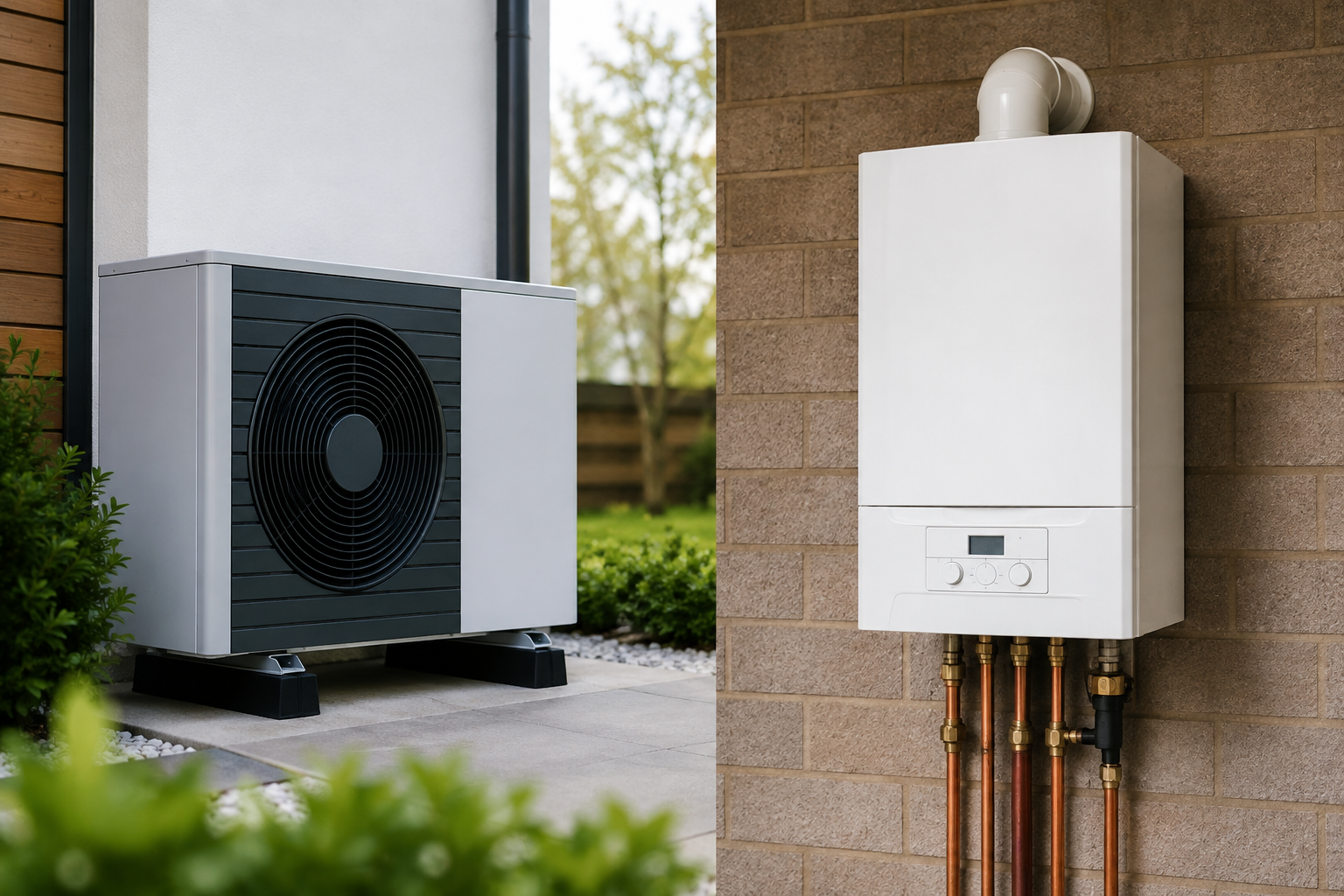
If your home currently relies on a gas boiler, you may be wondering whether it makes sense to replace it with a heat pump.
With SEAI grants available for home energy upgrades and more Irish homeowners looking to reduce their reliance on fossil fuels, heat pumps are becoming an increasingly popular alternative to traditional gas and oil heating.
But is a heat pump actually cheaper to run? Will it work in an older Irish home? And is it worth replacing a gas boiler that still works?
In this guide, we compare heat pumps vs gas boilers in Ireland and explain what homeowners should consider before making the switch.
Heat Pump vs Gas Boiler: What’s the Difference?
A gas boiler creates heat by burning natural gas. The boiler heats water, which is then circulated around your home through radiators or underfloor heating.
A heat pump works differently.
Rather than generating heat by burning fuel, a heat pump extracts heat from the surrounding environment – usually the outside air – and transfers it into your home.
The most common type installed in Irish homes is an air-to-water heat pump, which can provide both space heating and hot water.
Because a heat pump moves existing heat rather than creating it through combustion, it can use significantly less energy to heat a suitable home.
Is a Heat Pump More Efficient Than a Gas Boiler?
Yes. Heat pumps can be significantly more energy efficient than conventional fossil-fuel heating systems.
SEAI states that heat pumps use less than a third of the energy of an oil or gas boiler. However, that doesn’t automatically mean every home will achieve the same savings.
The efficiency of a heat pump depends heavily on the property itself.
Heat pumps work particularly well in homes with:
- Good attic and wall insulation
- Energy-efficient windows and doors
- Low levels of heat loss
- Appropriate radiators or underfloor heating
- Suitable heating controls
- Good airtightness and ventilation
This is why assessing your home before installing a heat pump is so important.
Is a Heat Pump Cheaper to Run Than a Gas Boiler in Ireland?
A properly designed heat pump in an energy-efficient home can significantly reduce the amount of energy required to keep the property warm.
However, comparing a heat pump with a gas boiler isn’t as simple as comparing the price of electricity with the price of gas.
A gas boiler consumes gas to create heat, while a heat pump can provide several units of heat for the electricity it consumes.
Your electricity usage will naturally increase after installing a heat pump, but your gas usage for space heating and hot water can disappear altogether.
Your actual running costs will depend on factors including:
- The size of your property
- Insulation levels
- Your home’s heat loss
- Electricity and gas prices
- Your preferred indoor temperature
- Heating controls
- The efficiency and design of the heat pump
- Your existing heating system
For that reason, homeowners should be cautious about generic online claims promising a particular percentage saving.
A home assessment provides a much better indication of whether a heat pump makes financial and technical sense for your property.
Can You Replace a Gas Boiler With a Heat Pump?
Yes.
In many Irish homes, an existing gas boiler can be replaced with an air-to-water heat pump.
However, you shouldn’t simply remove the boiler and install a heat pump without considering the rest of the house.
Heat pumps operate differently from traditional boilers and perform best when the property has a low level of heat loss.
For an older home, that may mean carrying out energy upgrades first.
These could include:
- Attic insulation
- Cavity, internal or external wall insulation
- New energy-efficient windows and doors
- Airtightness improvements
- Ventilation upgrades
- New or upgraded radiators
- Heating controls
This is one of the reasons a heat pump can work particularly well as part of a whole-home energy retrofit rather than as an isolated upgrade.
Does My House Need to Be Insulated Before Getting a Heat Pump?
In many cases, yes.
A poorly insulated home loses heat quickly. Installing a heat pump without addressing excessive heat loss can result in poorer performance and higher running costs.
SEAI advises that homes need to be sufficiently well insulated to benefit from a heat pump.
For homes built before 2007, a Technical Assessment may be required to establish whether the property is suitable for a heat pump.
One of the key measurements is the property’s Heat Loss Indicator (HLI).
If your home isn’t currently heat-pump ready, this doesn’t necessarily mean you can’t install one. Instead, the assessment can identify the improvements required to reduce heat loss and prepare the property for the new heating system.
What About Older Irish Homes?
Older homes can absolutely be upgraded to use heat pumps, but the process can be more involved.
A house built in the 1950s, 1960s or 1970s, for example, may have significantly different insulation levels from a modern property.
Depending on previous upgrades, it could require improvements to the building fabric before a heat pump is installed.
This is where a whole-house approach becomes particularly valuable.
Rather than asking:
“Can I replace my boiler with a heat pump?”
The better question is:
“What combination of upgrades will make my home warmer, more efficient and suitable for renewable heating?”
For some properties, insulation should be the priority. For others, the house may already be suitable for a heat pump.
An assessment can establish this before you commit to the installation.
How Much Is the SEAI Heat Pump Grant in Ireland?
There is now significant financial support available for homeowners switching away from fossil-fuel heating.
For qualifying houses, the current SEAI heat pump grant package can provide up to €12,500.
This can consist of:
- Up to €6,500 towards the heat pump system
- Up to €2,000 towards necessary central heating upgrades, such as radiators or underfloor heating
- A €4,000 Renewable Heat Bonus for eligible homeowners replacing an existing fossil-fuel heating system, including a gas or oil boiler
Apartments have different maximum grant amounts.
There is also a €200 grant towards a Technical Assessment where applicable.
Grant eligibility depends on the property and the work being carried out, so homeowners should establish what support they qualify for before beginning work.
Importantly, SEAI does not currently provide grants towards installing new or replacement standalone gas or oil boilers.
Should I Replace a Working Gas Boiler?
Not necessarily.
If your gas boiler is relatively new, reliable and your home hasn’t yet been properly insulated, replacing the boiler may not be the first upgrade you should make.
Improving your home’s insulation could provide a better starting point.
On the other hand, if you have:
- An ageing gas boiler
- High heating demand
- A poorly performing BER
- Plans to renovate your home
- Insulation upgrades already planned
- A desire to move away from fossil fuels
…it may make sense to consider a heat pump as part of the wider project.
Planning the upgrades together can prevent you from spending money on a heating system today that you intend to replace again in a few years.
Heat Pump vs Gas Boiler: Pros and Cons
Advantages of a Heat Pump
High energy efficiency
Heat pumps require considerably less energy to provide heat than conventional fossil-fuel systems.
No gas required for heating
Replacing your gas boiler allows you to move away from fossil-fuel heating.
SEAI grant support
Significant grant funding is currently available towards qualifying heat pump installations and associated works.
Consistent indoor temperatures
Heat pumps are designed to maintain a comfortable, steady temperature rather than repeatedly heating and cooling the property.
Can improve your BER
Installing a heat pump as part of an appropriate home energy upgrade can contribute towards a substantially improved Building Energy Rating.
Works well with other upgrades
Heat pumps can be combined with insulation, ventilation, windows, doors and solar PV as part of a whole-home retrofit.
Things to Consider Before Installing a Heat Pump
Your home needs to be suitable
Insulation and heat loss need to be considered before installation.
Higher upfront investment
Even with grants, installing a heat pump can involve a larger initial investment than simply replacing a boiler.
Radiators may need upgrading
Some existing radiators may need to be replaced or resized to work effectively with lower-temperature heating.
It needs to be properly designed
Heat pump sizing and system design are extremely important. Bigger isn’t necessarily better.
What Happens to My Radiators?
You don’t automatically need to replace every radiator when switching to a heat pump.
However, your heating system needs to be assessed.
Heat pumps typically operate at lower water temperatures than traditional gas boilers. Depending on the heat requirements of individual rooms, some radiators may need to be increased in size or replaced.
SEAI’s current heat pump grant package recognises this by providing up to €2,000 towards qualifying central heating system upgrades where they are required.
A proper heat-loss calculation should be used to determine the heating requirement for each room before the new system is designed.
Heat Pump or Gas Boiler: Which Is Better for Your BER?
If improving your home’s BER is one of your main objectives, a heat pump will generally have considerably more potential than simply replacing one fossil-fuel boiler with another.
But the heating system is only one part of your BER.
Your rating considers the overall energy performance of the property, including areas such as insulation, heating, hot water and renewable energy.
That’s why the biggest improvements can often come from combining measures.
For example:
Insulation + Heat Pump + Solar PV + Ventilation
can form part of a comprehensive energy upgrade designed to dramatically improve the overall performance of an older home.
Is It Worth Switching From a Gas Boiler to a Heat Pump?
For the right home, yes, switching from a gas boiler to a heat pump can be a very worthwhile long-term upgrade.
But the crucial phrase is the right home.
Installing a heat pump into a poorly insulated property without first understanding its heat loss isn’t the approach we’d recommend.
Instead, homeowners should look at the property as a complete system.
- How much heat is the house losing?
- What insulation is already present?
- What BER could the property achieve?
- Do the radiators need upgrading?
- What SEAI grants are available?
- And which combination of measures gives the homeowner the best overall result?
Answering those questions first allows you to make an informed decision about whether switching from gas to a heat pump is right for your home.
Find Out If Your Home Is Suitable for a Heat Pump
At House2Home, we help homeowners across Ireland plan and complete comprehensive home energy upgrades.
As an SEAI registered One Stop Shop, we can assess your property, identify suitable energy upgrades and manage the retrofit process from assessment through to completion.
This can include measures such as:
- Heat pumps
- Attic and wall insulation
- Windows and doors
- Solar PV
- Ventilation
- Heating upgrades
- BER improvements
Through the One Stop Shop route, eligible SEAI grant funding is deducted upfront from the cost of the works, rather than requiring you to fund the grant amount and claim it back afterwards.
If you’re considering replacing your gas boiler with a heat pump, the first step is understanding what your home actually needs.
Start your home energy upgrade with House2Home and find out which measures could improve the comfort, efficiency and BER of your property. Find out how much your home energy upgrades could cost through our cost calculator.