

If you’re thinking about upgrading your home’s energy efficiency, one of the first questions you’re likely to ask is: How long does a deep retrofit take in Ireland?
Whether you’re planning to install a heat pump, improve your insulation or undertake a complete home energy upgrade, understanding the timeline can help you prepare for the work ahead.
The answer depends on your home’s age, condition, the upgrades required and the complexity of the project.
A deep retrofit is not simply a matter of contractors arriving and starting work. There are several important stages, including the initial assessment, technical planning, grant arrangements, construction and final certification.
At House2Home, we help homeowners navigate these stages through our One Stop Shop service.
How Long Does a Deep Retrofit Usually Take?
A deep retrofit can take several months from your initial enquiry to final completion, although the actual construction work may take only a few weeks for a relatively straightforward project.
Larger or more complicated retrofits can require several months of on-site work.
The overall process includes:
- Initial enquiry and consultation
- Home Energy Assessment
- Technical design and quotation
- Grant arrangements and project scheduling
- Retrofit construction works
- Final inspections and BER certification
It is important to distinguish between the time spent preparing for your retrofit and the time contractors are physically working on your property.
Let’s look at each stage in more detail.
Stage 1: Initial Enquiry and Home Energy Assessment
Typical House2Home assessment appointment lead time: 3–4 weeks, subject to availability.
The first step is understanding your home’s current energy performance and identifying the improvements required.
At House2Home, homeowners can begin by completing our free online Home Energy Upgrade Cost Calculator.
This takes approximately three minutes and provides an initial estimate of potential upgrade costs and available SEAI grants.
Try Our Home Energy Upgrade Cost Calculator
The next step is a Home Energy Assessment (HEA).
During this process, a qualified assessor examines your property and considers factors such as:
- Existing insulation levels
- Current heating system
- Windows and doors
- Ventilation and airtightness
- Overall building energy performance
- Suitability for a heat pump
The assessment produces a technical report outlining recommended upgrades, potential BER improvements and estimated costs.
At House2Home, the Home Energy Assessment costs €700. An eligible SEAI grant of €350 reduces the net cost to €350.
If you proceed with House2Home for your retrofit works, we refund that €350 against your project cost.
Stage 2: Reviewing Your Retrofit Recommendations
Once your Home Energy Assessment has been completed, the next stage is reviewing the recommended improvements.
Every home is different.
For example, a 1970s semi-detached house with an E-rated BER may require a more extensive upgrade than a modern property already rated C1.
Recommended works could include:
- External or internal wall insulation
- Attic insulation
- Replacement windows and doors
- An air-to-water heat pump
- Ventilation improvements
- Solar PV panels
The proposed measures must work together to achieve the required energy performance.
Your assessment also helps identify whether additional technical work or investigations are necessary before construction can begin.
Stage 3: Finalising Your Quote and SEAI Grants
Before work begins, the proposed retrofit must be properly planned and costed.
This stage involves reviewing the technical recommendations, confirming the scope of works and establishing which SEAI grants are available.
Through the SEAI One Stop Shop scheme, eligible homeowners can receive support towards a range of energy improvements.
A key benefit of the One Stop Shop approach is that eligible grants are deducted upfront from the cost of the works, rather than requiring homeowners to claim them individually afterwards.
House2Home can help coordinate the grant process as part of your whole-home energy upgrade.
The time required at this stage depends on the complexity of the project, the technical requirements and the availability of contractors and materials.
Stage 4: Carrying Out the Retrofit Works
This is the stage most homeowners are concerned about.
How long will builders and installers actually be working in the house?
For a straightforward retrofit, the construction phase may take several weeks. More extensive projects involving major insulation, heating, windows and structural alterations may take considerably longer.
The work typically follows a coordinated sequence.
Insulation Upgrades
Improving the building fabric is an important part of many deep retrofits.
This may involve installing external wall insulation, upgrading attic insulation or insulating floors.
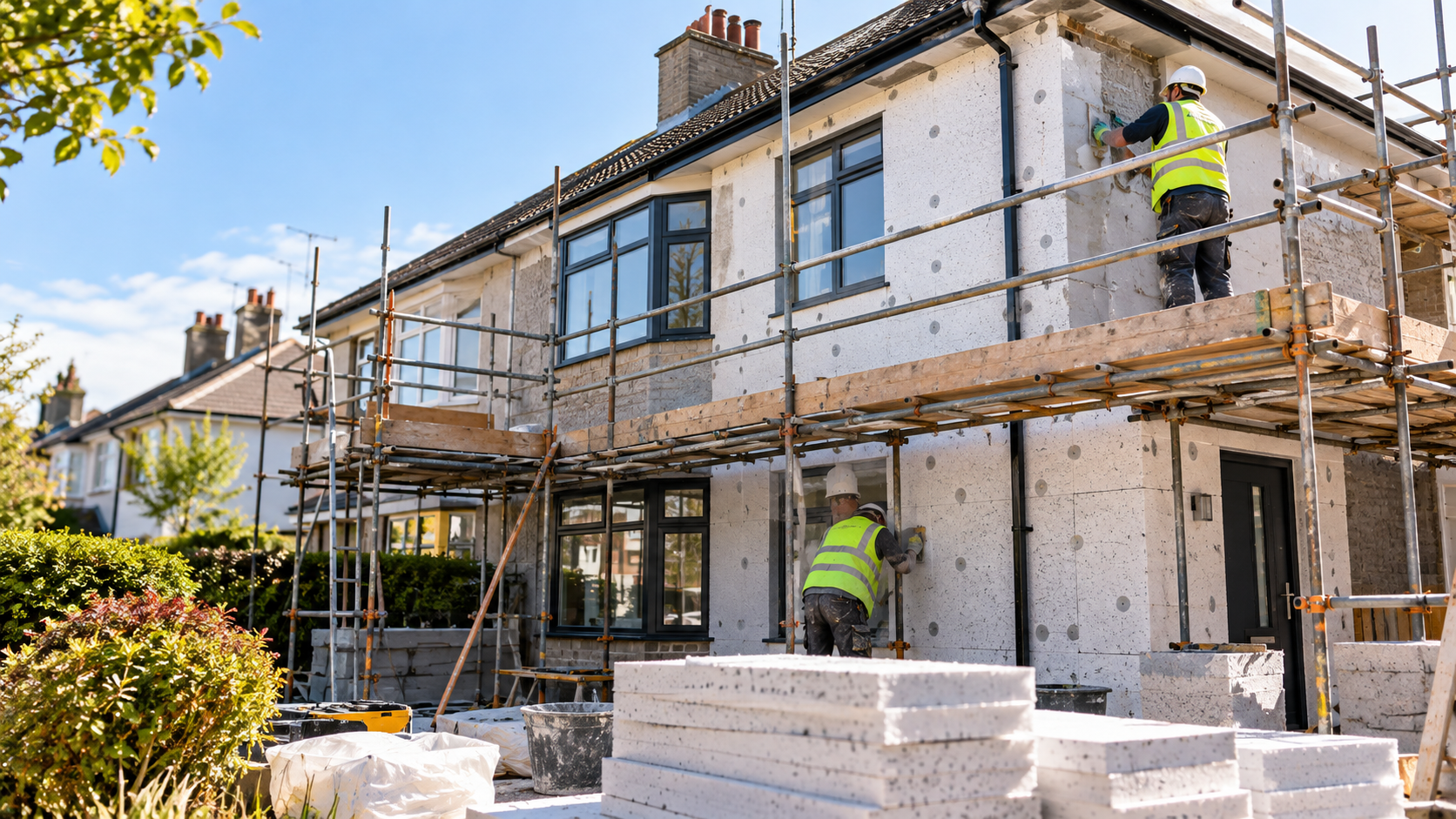
External wall insulation can involve scaffolding, preparation of existing surfaces, insulation installation and finishing works.
The duration depends on the size of the property, its construction and weather conditions.
Windows and Doors
Replacing older windows and doors can improve thermal comfort and reduce draughts.
Installation must be coordinated with other works, particularly where external wall insulation is being fitted.
This helps ensure that insulation and window details are completed correctly.
Heat Pump Installation
An air-to-water heat pump can be an important part of a comprehensive energy upgrade.
Depending on the property, installation may involve replacing the existing heating system, upgrading radiators and installing a new hot water cylinder.
The heating system must be designed to suit the home’s heat loss and heating requirements.
Ventilation and Airtightness
As homes become better insulated and more airtight, suitable ventilation becomes increasingly important.
Ventilation upgrades may be required to maintain healthy indoor air quality and manage moisture.
Solar PV Installation
Solar panels may also form part of the retrofit.
Installation needs to be coordinated with the electrical requirements of the home and the wider project schedule.
Stage 5: Final Inspections and BER Certification
Once the construction work has been completed, the project moves into its final stage.
This can include checking the completed installations, commissioning the heating system, reviewing relevant documentation and arranging the post-works Building Energy Rating assessment.
The final BER assessment confirms the home’s energy performance following the upgrades.
For eligible One Stop Shop projects, the required BER and energy performance criteria must be achieved.
The final certification process is an important part of confirming that the home has been upgraded to the appropriate standard.
Can You Live in Your House During a Deep Retrofit?
One of the most common concerns homeowners have is whether they will need to move out while work is being carried out.
In many cases, homeowners can remain in their property during a retrofit.
However, this depends on the extent and nature of the works.
External wall insulation and attic insulation may be possible while the property remains occupied, although there will still be disruption.
More extensive works involving internal wall insulation, floor replacement, major heating alterations or structural renovations may make temporary alternative accommodation advisable.
If you’re planning a particularly comprehensive renovation, it may be more practical to carry out the work while the property is unoccupied.
The best approach is to discuss this during the planning stage so that you understand what to expect.
Get in touch with House2Home to discuss your traditional home retrofit and the SEAI supports that may be available.
👉 Calculate Your Home Energy Upgrade Cost
If you’d rather speak to the House2Home team about your property and the retrofit process, you can also book a free 30-minute call: